And then there is this in the one-page preface to the 1990 edition:
Wednesday, September 10, 2014
Phlosophy
And then there is this in the one-page preface to the 1990 edition:
Friday, September 05, 2014
Growing apart
εἰ δ' ὃ μὲν διαμένοι ὃ δ' ἐπιεικέστερος γίνοιτο καὶ πολὺ διαλλάττοι τῇ ἀρετῇ, ἆρα χρηστέον φίλῳ; ἢ οὐκ ἐνδέχεται; ἐν μεγάλῃ δὲ διαστάσει μάλιστα δῆλον γίνεται, οἷον ἐν ταῖς παιδικαῖς φιλίαις· εἰ γὰρ ὃ μὲν διαμένοι τὴν διάνοιαν παῖς ὃ δ' ἀνὴρ εἴη οἷος κράτιστος, πῶς ἂν εἶεν φίλοι μήτ' ἀρεσκόμενοι τοῖς αὐτοῖς μήτε χαίροντες καὶ λυπούμενοι; οὐδὲ γὰρ περὶ ἀλλήλους ταῦθ' ὑπάρξει αὐτοῖς, ἄνευ δὲ τούτων οὐκ ἦν φίλους εἶναι· συμβιοῦν γὰρ οὐχ οἷόν τε. εἴρηται δὲ περὶ τούτων.
But if one friend remained the same while the other became better and far outstripped him in virtue, should the latter treat the former as a friend? Surely he cannot. When the interval is great this becomes most plain, e.g. in the case of childish friendships; if one friend remained a child in intellect while the other became a fully developed man, how could they be friends when they neither approved of the same things nor delighted in and were pained by the same things? For not even with regard to each other will their tastes agree, and without this (as we saw) they cannot be friends; for they cannot live together. But we have discussed these matters. (Trans. W. D. Ross)
NE 9.3 1165b23–31
Anyway, it reminded me of this: Julie Walters being brilliant in a brilliant film. Because moving apart can be painful on both sides. Both people lose something, whatever else one of them may have gained.
Monday, August 25, 2014
Diogenes of Oinoanda conference
I'm disappointed not to be able to go to this conference on Diogenes Oinoanda, to be held next month at the universities of Istanbul and Muğla, close to Oinoanda itself. There's a very good set of participants and Diogenes deserves this level of detailed attention. The website has links to abstracts of the papers.
Université Galatasaray – ISTANBUL
Première Journée – 22. 09. 2014 Lundi
09.00 – 09.45 Accueil des participants
10.00 – 10.20 Ouverture du colloque
10.20 – 11.20 Francesca Masi (Università Ca’Foscari – Venezia) « Pleasure, Virtue and Cause. Diogenes of Oenoanda and the Stoics »[Abstract]
11.20 – 12.20 Voula Tsouna (University of California – Santa Barbara) « Diogenes of Oenoanda on the Cyrenaics and the Sceptics » [Abstract]
12.30 – 14.00 Déjeuner
14.00 – 15.00 Francesco Verde (Università Roma I – ‘La Sapienza’) « Plato’s Demiurge (NF 155) and Aristotle’s Flux (fr. 5 Smith): Diogenes of Oinoanda on the History of Philosophy » [Abstract]
15.00 – 16.00 Michael Erler (Julius–Maximilians – Universität Würzburg Institut für Klassische Philologie) « Diogenes against Plato. Diogenes’ Critique and the tradition of Epicurean Antiplatonism » [Abstract]
16.00 – 16.20 Pause
16.20 – 17.20 Jean-Baptiste Gourinat (CNRS UMR 8061, Centre Léon Robin) « La critique des stoïciens dans l’Inscription » [Résumé]
Deuxième Journée – 23.09.2014 Mardi
10.00 – 11.00 Dirk Obbink (University of Oxford) « Diogenes of Oenoanda on the Gods » [Abstract]
11.00 – 12.00 Alain Gigandet (Paris) « Diogène d’Oenoanda fr. 9 – Lucrèce, IV, 973-86: un élément-clé de la théorie épicurienne de l’imaginaire »
12.00 – 13.30 Déjeuner
Université de MUGLA
Troisième Journée – 24.09.2014 Mercredi
09.00 – 10.00 Accueil des participants
Inaugural speech by
Fahri Işık (Burdur – Mehmet Akif Ersoy University) « The Anatolian Character of the Lycian Civilisation »
10.00 – 11.00 Martin Bachmann (Deutsches Archäologisches Institut – Istanbul) « Framework and Results of the Oinoanda Survey Project 2007-2012 » [Abstract]
11.00 – 12.00 Jürgen Hammerstaedt (Universität zu Köln) « The importance of the site of Oinoanda and its inscriptions for interdisciplinary research, the cultural heritage and the society of the 21st century »[Abstract]
12.00 – 12.30 Pause
12.30 – 13.30 Geert Roskam (KU Leuven – Catholic University of Leuven) « Diogenes’ Polemical Approach, or How to Refute a Philosophical Opponent in an Epigraphic Context » [Abstract]
13.30 – 14.30 Déjeuner
14.30 – 15.30 Pierre-Marie Morel (Université Paris 1 Panthéon – Sorbonne UMR 7219 – Institut Universitaire de France) « Diogène d’Œnoanda et la politique » [Résumé]
15.30 – 16.30 Giuliana Leone (Università degli Studi di Napoli Federico II) « Diogène d’Oenoanda et la polémique sur les meteora » [Résumé]
16.30 – 16.45 Pause
16.45 – 17.45 Refik Güremen (Mimar Sinan University – Istanbul) « Diogenes of Oinoanda and the Epicurean Epistemology of Dreams »[Abstract]
Clôture du colloque
Comité d’organisation
Pierre-Marie Morel (Université Paris I Panthéon – Sorbonne)
Jürgen Hammerstaedt (Universität zu Köln)
Refik Güremen (Université Mimar Sinan – refikg2001@yahoo.com )
Ömer Orhan Aygün (Université Galatasaray)
Pour toute information : refikg2001@yahoo.com
Monday, August 18, 2014
Hooray for September
So what have I managed to do this summer? Well, the proofs of the book are done, I hope, so I will receive at some point in November or so the first copies. (Is it a bit sad to be really excited about that? Well, I don't care. I am.) And I've been working on some new lectures for next term: a chance to get back into some of the nitty gritty of the Nicomachean Ethics. And a lecture for the Cambridge Festival of Ideas in October. There's the various bits of admin, refereeing, and examining too. But not a tough summer by any means.
I think I tend to underestimate the time I have before term. I think it's because the kids will be going back to school in a couple of weeks and it's hard not to feel as if that really is the beginning of term and the end of the vacation. Anyone who's an academic in the UK and has kids will think of July and September as golden times: term has mostly finished by July and doesn't really get going until October so these are the two months when the children are back at school and the wrangles over childcare go away but the madness of the university term hasn't really hit.
This September, I'll be busy as part of a team arranging and then participating in a conference in Cambridge but it's still, despite Michaelmas looming, one of my favourite times of the year.
Monday, August 04, 2014
AuthorHub PR
I'm off to scout locations. Iceland seems nice.
Thursday, July 17, 2014
Pleasure and temple-building II
There are some things I still find puzzling:
a. There is no need to think that these changes that make up the overall business of making a temple have to happen in a sequence such that we cannot start making a triglyph until we’ve put down the base. True, we certainly can’t put the roof on until the columns are up. But if we think that constructing the Parthenon took a certain length of time to complete, it’s not true that making the base and carving the triglyph are distinct temporal parts in the sense that they are non-overlapping periods within the overall period of constructing the Parthenon. Indeed, it seems possible that the base was constructed and the triglyph was carved at the same time: these processes both took place over the very same duration and lasted exactly the same length of time. So perhaps this is just to say that I don’t find the temple-building case such a clear illustration of the general point he wants to make because I don’t think it is a prima facie analogue of a potential counter-example.
b. What is the motivation for this strange example? Here I wonder if there is just some metaphysical background we don’t have spelled out in full. Later in the chapter we are referred for more information to the Physics so perhaps that is the next place to look. Perhaps he thinks he might be under fire from some smart reader who thinks that if you chop a change up into smaller temporal parts we might say that some parts are complete when the whole is not.
c. What does Aristotle himself say about cases like the pleasures we experience in the process of quenching a thirst? Take a moment or period during the whole change: the whole change is not yet complete. But nevertheless it seems odd to maintain that we are not enjoying removing the thirst. In book 7 Aristotle takes the view that cases such as the pleasures involved in the process of being restored to health ought to be understood as due to the activity of the remaining healthy part. He claims that this sort of thing is pleasant per accidens because there is the ‘activity [energeia] of the underlying condition and nature’ (7.12 1152b33–1153a2; see also 1154b17–20). It's not entirely clear what he means by this but it is evident that he wants to locate an activity somewhere and attributes this to some part of aspect of the patient that is in the healthy state even as health is being restored [1].
| Some people restoring a temple. Note that the columns have been fluted... |
What is different between this case and the construction of a temple? Can’t I say that in both there is an energeia of a complete state: in one case part of the person is hydrated and in a natural state and in the other case part of the temple has been completed? In both cases the amount of the person that is hydrated and healthy and the amount of a temple that is completed gradually increases? Is this different from the temple-building case because it is a return to a natural condition? So the analogue between the pleasure of restoring health would be the restoration of a temple (where there is always some of the complete temple present) rather than the construction of a new temple. But in that case, why should it matter whether, so to speak, this is a restoration or a new build?
[1] J. Aufderheide 2013,‘Processes as pleasures in EN vii 11–14: a new approach’, Ancient Philosophy 33: 135–57 has some important remarks about how we should analyse occasions like the pleasures of being restored to health. When an animal heals or sustains itself, for example, the agent-activity involved is the activity of the residual natural state. (This is doing the job that is performed by the doctor in the case where a patient is entirely passive and is healed solely through the agency of someone else.) It is this activity, in fact, which is a pleasure. It is the activity of this healthy part which is responsible for the pleasure. The person’s undergoing the process is only incidentally pleasant. See also Frede, D. (2009) ‘NE VII.11–12: Pleasure’, in C. Natali (ed.) Aristotle: Nicomachean Ethics VII. Oxford: Oxford University Press: 183–208 194-5.
Thursday, July 10, 2014
Tactics...
You don't get Adrian Chiles inviting anyone to do that. Last night's Argentina v. Netherlands game was tactically very sophisticated and interesting but the discussion was very flat: what a shame it wasn't another 7-1 drubbing.... There is some interesting discussion of the English culture of watching, commentating on and discussing football here.
Friday, July 04, 2014
Thomas Jefferson, a man of great discernment...
Here are some of Thomas Jefferson's thoughts on ancient philosophy (borrowed from here):
Thomas Jefferson to John Adams, July 5, 1814:
…. I am just returned from one of my long absences, having been at my other home for five weeks past. Having more leisure there than here for reading, I amused myself with reading seriously Plato’s Republic. I am wrong, however, in calling it amusement, for it was the heaviest task-work I ever went through. I had occasionally before taken up some of his other works, but scarcely ever had patience to go through a whole dialogue. While wading through the whimsies, the puerilities, and unintelligible jargon of this work, I laid it down often to ask myself how it could have been, that the world should have so long consented to give reputation to such nonsense as this? How the soi-disant Christian world, indeed, should have done it, is a piece of historical curiosity. But how could the Roman good sense do it? And particularly, how could Cicero bestow such eulogies on Plato! Although Cicero did not wield the dense logic of Demosthenes, yet he was able, learned, laborious, practised in the business of the world, and honest. (continues...)
Thomas Jefferson to William Short, October 31, 1819
As you say of yourself, I too am an Epicurean. I consider the genuine (not the imputed) doctrines of Epicurus as containing everything rational in moral philosophy which Greece and Rome have left us. Epictetus indeed, has given us what was good of the stoics; all beyond, of their dogmas, being hypocrisy and grimace. Their great crime was in their calumnies of Epicurus and misrepresentations of his doctrines; in which we lament to see the candid character of Cicero engaging as an accomplice. Diffuse, vapid, rhetorical, but enchanting. His prototype Plato, eloquent as himself, dealing out mysticisms incomprehensible to the human mind, has been deified by certain sects usurping the name of Christians; because, in his foggy conceptions, they found a basis of impenetrable darkness whereon to rear fabrications as delirious, of their own invention... (continues...)
Wednesday, July 02, 2014
Pleasure and temple-building I
It’s the passage where Aristotle tries to help us to understand the ways in which activities (energeiai) differ from changes (kinēseis) with an illustration from the business of temple building.
The principal point he wants to establish is:
1. Every kinēsis takes time, has a telos, and is complete only when that telos is achieved (1174a19–21).
The illustration here is the kinēsis: ‘housebuilding’. It is complete only when its telos, the building of a house, is reached.
The lines that I find puzzling come next1(174a21–3):
ἢ ἐν ἅπαντι δὴ τῷ χρόνῳ ἢ τούτῳ. ἐν δὲ τοῖς μέρεσι καὶ τῷ χρόνῳ πᾶσαι ἀτελεῖς, καὶ ἕτεραι τῷ εἴδει τῆς ὅλης καὶ ἀλλήλων.
Rowe’s translation: ‘So that will be either in the whole time, or in this. But if it is divided up into temporal parts, the resulting movements are all incomplete, and distinct in form both from the whole and from each other.’
I think that this is supposed to introduce a complication and provokes Aristotle to explain that 1. remains true even in these more complicated cases. The complicated cases have to do with being able to distinguish various parts (merē) of a kinēsis.
In these cases:
2. All these kinēseis that are parts of a kinēsis (a) are also incomplete in time (b) differ from one another in kind and (c) also differ (sc. in kind?) from the whole.
In the next chapter Aristotle will also have things to say about how energeiai differ from one another in kind. So 2b is not something true of kinēseis but not of energeiai. The most important point therefore seems to be 2a: dividing up a change into various parts is not going to prevent us from saying that all kinēseis are ateleis.
The illustration seems to work as follows. Unlike the simple case of housebuilding now we have a more complicated (and, I presume, more costly and important and laborious and ethically and politically significant) case of building a temple. Building a temple is a change and it has various parts and stages and it takes a period of time. Some of the stages have to be done before others but the temple as a whole is not complete until all of the stages are completed.
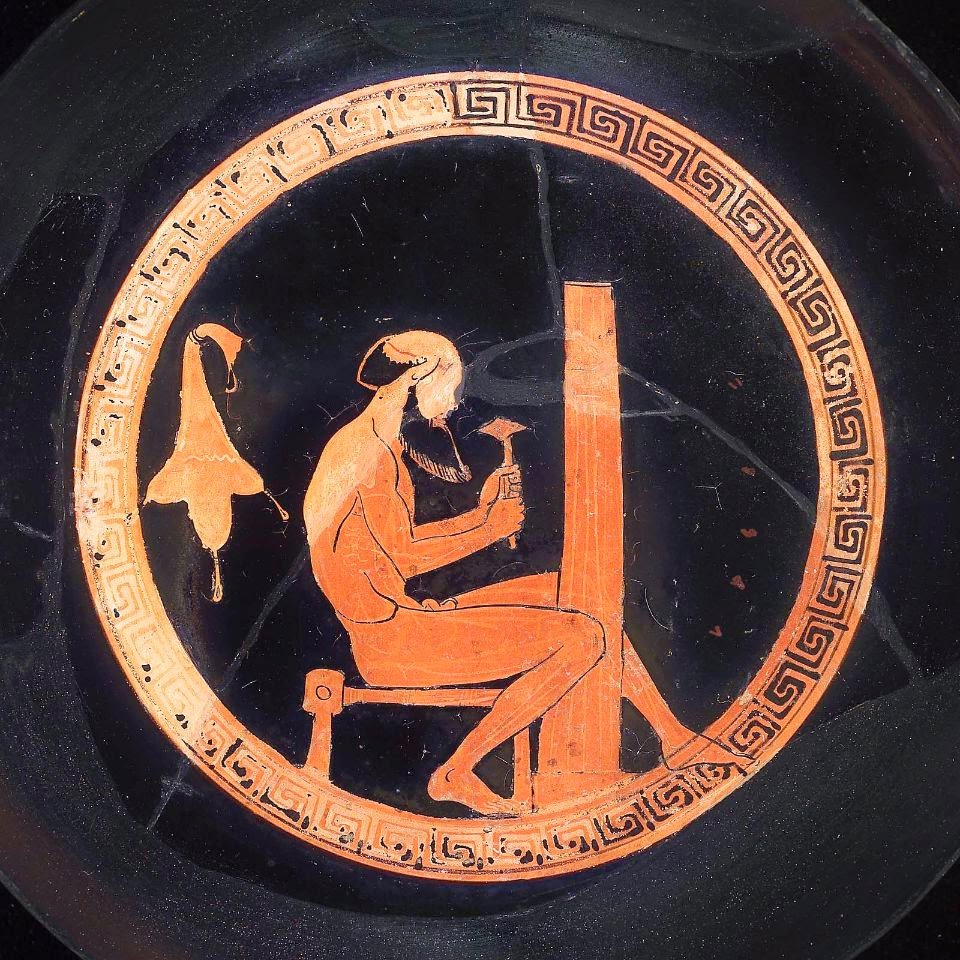
Here is a picture of some people building a temple who have already finished various bits of it. They have made the base of a column, for example, but they have not put on the roof:
Aristotle's illustration uses examples of some of the various different things that have to be done when you build a temple. It illustrates 1 and 2 in reverse order from the order in which they were introduced in a19–23).
3. Placing the stones together (hē tōn lithōn synthesis) is different from fluting a column [illustrates 2b] and both of these are distinct from the making of the temple [illustrates 2c]
Here is a picture of a satyr fluting a column:
4. The construction of the temple is complete (hē men tou naou [sc. poiēsis?] teleia) for it lacks nothing, while the making of the base or the triglyph is incomplete because each is a part.
This is then resumed at a27–9 where Aristotle says that he has shown that these changes differ in kind from one another and are complete, if at all, only in the whole.
In 4, presumably the idea is that making a base and making a triglyph are parts of making the temple and that is why they are incomplete unless and until the temple is complete.
Perhaps we should think that these parts are to be understood as parts of a temple in the sense that the triglyph on Pheidias’ workbench is not a completed triglyph even if there is no more carving to do because it can be a triglyph proper only once it is in its place in the fully constructed Parthenon. This, I suppose, is how he thinks he can maintain 2a: we can’t identify component kinēseis of a larger whole kinēsis such that those component kinēseis are complete even when the larger kinēsis is not.
If that is what he wants to show then I suppose I get his point. But then I have some questions and puzzles about why he is bothered about this and whether this is a good case for him to use to show why 1 still holds. Those are for next time, unless someone shows that what I have here is already confused.
Friday, June 20, 2014
Tuesday, June 17, 2014
Crumbs, DM!
In the meantime, some good news. Danger Mouse is coming back to the telly in a new series.
Wednesday, June 04, 2014
Tuesday, June 03, 2014
Tom's Diner
Thursday, May 29, 2014
Valedictions
And tomorrow at 5pm David Sedley will give his valedictory in Cambridge (room G.19 in the Faculty of Classics): 'Godlikeness'.
Wednesday, May 28, 2014
Vacancy: Temporary Teaching Associate in Ancient Philosophy – maternity cover
More details on the Faculty's website here.
Wednesday, May 21, 2014
Books
Monday, May 12, 2014
The retiring Mr Cole
I suppose the chronology is important here. Ashley made himself available for selection but was not selected. After he was not selected he retired.
It certainly can’t be the case, therefore, that he is himself responsible for not playing for England at the 2014 World Cup. But, you might say, the retirement is mean differently: Ashley is saying that he now chooses not to play for England at any point in the future after the World Cup. Surely he can be responsible for that since it is not yet the case that Mr Roy (or whoever takes over) has prevented him from playing for England in, say, the 2016 European championships. So Ashley can be said to be responsible for not playing in the 2016 European championships even if it is a bit odd to say he is responsible for not playing in the 2014 World Cup.
True. But there is an a fortiori argument here. Since Ashley was not selected for the 2014 World Cup a fortiori he will not be selected for the 2016 European championships. (The World Cup is the competition for which Mr Roy will select his preferred squad; Ashley is at a stage of his career when he is now less likely to be selected for each subsequent tournament.)
True, it may be that all other younger left-backs will be injured just before the 2016 tournament and Mr Roy (more likely someone else) will come begging for Ashley (who will then be 35) to play. But no, Ashely will not play because he has chosen to retire. Perhaps. But very very unlikely. And I suspect Ashely knows it.
So, let’s see this as a bit of face-saving on the part of a player who has played more than a hundred times for his country and has now come to the end of his international career. Whether he chose to end it or not.
Tuesday, May 06, 2014
The joy of indexing
I have made a list of the references (e.g. Arist. NE 10.5 1175b34–6) and put these in order in a Word document. Then I highlight all the references in the printout and assign to each of them a code. Then I enter that code number next to the appropriate reference in the list. (So: I write 'L287' on the page next to the highlighted bit and then type 'L287' next to the reference in my Word document.) I've got up to nearly 800 references now; it's enough to discourage you from referring to the texts when you're writing the thing in the first place.
I can see the point of this procedure -- it allows hyperlinks between the index and the main text and, if the page layout is changed, the links will adapt. But it's a bit of a pain. And I haven't even started on the 'Subject' index. (On the whole, I think that's probably the less useful. At least, I'm more likely to look up what's said about a particular passage than about a particular theme or idea and since most of the themes and ideas worth looking up work their way through the whole book then I'm trying to avoid including them at all. The contents page is a better guide for the reader.)
But, in the end, there will be something to show for it all...
There's more info on the CUP website here.
Thursday, April 24, 2014
Out and about
And I've come back refreshed from a lovely but brief visit to Iceland. I gave a seminar and a lecture (at the kind invitation of a colleague there) and we all then got to spend a few days looking around Reykjavik and the immediate area. Here is one of those 'panorama' photos of the harbour.
It's a beautiful place.
For the rest, in no particular order in the next couple of week I have to:
... work out what I think about a bit of Ps. Aristotle MXG for our Mayweek seminar. (It would help if the text were more stable and were not 75% composed of parts of the verb to be and assorted definite articles...)
... read R. Jay Wallace's The View from Here. I've decided that 'regret' (metameleia) in ancient philosophy is something I want to think more about and, in particular, whether and why a fully virtuous person might ever come to regret some past action or some past decision. I'm also interested in a more radical kind of regret: 'existential regret', thinking that it would have been better never to have been born. This looks to be a great place to begin.
... think a bit about a possible research project I might be hatching with another colleague here in Cambridge. We all have to have a project in the pipeline these days, and this idea is at least something that promises to be challenging and interesting.
... prepare a short lecture for the Oxford-Cambridge Classics Open Day for VI formers (2 May). I think Plato's Protagoras is a set text for A level Greek at the moment but students only read a small chunk of it. The plan is to try to say something that is both relevant to that bit they have to study and also broadens the focus into other parts of the dialogue and into interesting philosophical arguments.