I'm very tempted to get tickets to the They might be giants Science Festival concert at the end of the month in the Babbage Lecture theatre. More details here. Here they are telling you about the Sun.
and here they are telling you about palaeontology.
Friday, June 04, 2010


Thought gang
Thought some of you might find this funny, from Tibor Fischer's The Thought Gang (p.19):
I made the Ionians my speciality. Very few people realise that you can read the entire extant oeuvre of the Ionians, slowly and carefully, in an hour. Most of them come in handy packets and adages. Extremely impotant, the first caught having a go with their reason, the inventors of paid thought and science - anything you'll find in a university - and blissfully curt.
Wednesday, June 02, 2010
Loofa
Was it just me or did Loofa (Idris Elba) last night ask his chum to get details on a crim from Detective Munch in New York? Is he a Homicide: Life on the Streets fan? (Wikipedia says so...)
Sunday, May 30, 2010
Big Ethics
In between the usual business of college life and dealing with the onset of undergraduate exams, I spent last week at the Mayweek seminar reading through the Magna Moralia. It was quite pleasant, really, particularly since the participants seemed all keen to muck in and no one had anything very much invested in what we would eventually conclude (so there wasn't very much personally and professionally at stake).
I don't think I would have read it through like this left to my own devices and I probably won't rush to read it through like that again. But there were some good parts. I thought there were some interesting questions concerning the author's relationship to Platonism since he did seem to have been pulling his punches here and there particularly on metaphysical issues. The general disfavour of an intellectual or contemplative life is interesting too -- and here I did begin to wonder if MM might be part of the general milieu of the Peripatos that also spawned the difference of opinion between Dicaearchus and Theophrastus on the good life. And there were some interesting thoughts about the relationship of this text to the Hellenistic penchant for pseudepigrapha since the text does seem to want to appear as if composed by Aristotle himself. (If there was any general agreement, I think we nearly all agreed that the text wasn't by Aristotle, partly because bits of it were so close to NE and EE that the most plausible explanation is that they were composed by someone working with these two texts.)
Thursday, May 27, 2010
Action philosophers
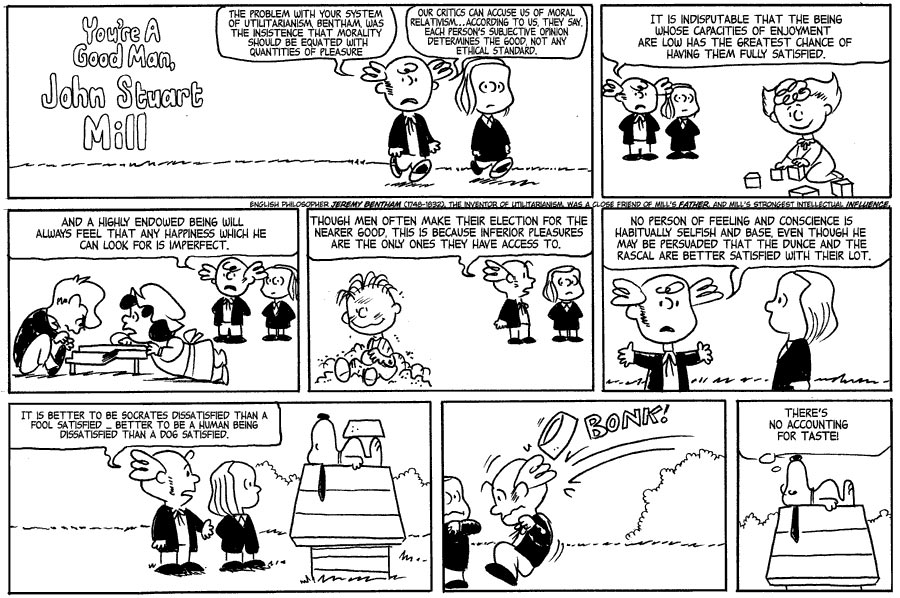
I might write something about our Mayweek Magna Moralia seminar once I've decided what I think about it all. But for now, here is a wonderful page from Van Lente and Dunlavey's Action Philosophers. (Click on it to make it big.)
Sunday, May 23, 2010
Sunny music
I know some people are already bored about me going on about them, but you really should all listen to and love Camera Obscura. We had this on while driving home in the sun this afternoon and we all felt very happy. And the CD cover has these two on it with great hats and a snazzy pair of glasses:
No video for that one, unfortunately, but it's a real toe-tapper. And this is lovely too:
And this one has one of the best choruses I've heard for ages. The cheesy intro from the TV presenter is bad, but once the song begins it's brill:
No video for that one, unfortunately, but it's a real toe-tapper. And this is lovely too:
And this one has one of the best choruses I've heard for ages. The cheesy intro from the TV presenter is bad, but once the song begins it's brill:
Friday, May 21, 2010
Oh dear
Times columnist Sathnam Sanghera thinks it would be a good idea to study consciousness. He's right. But he also thinks it is a good idea only so long as you don't do any philosophy and it's all just useful things that involve studying brains and neurons and things. I don't think this is right. Sure, studying brains is a good idea. But why does that mean studying philosophy is not? He explains:
Indeed, a bit of me dies whenever young people say that they want to study philosophy at university. There is a naive view that three years spent pondering questions such as “Why does God allow bad things to happen to good people?” and “Why are we here?” will help you to understand the meaning of life, when the truth is that philosophy is the most whimsical and self indulgent of academic pursuits, raising more questions than answers and too often being an exercise in intellectual showing off for those involved.
Let's leave aside for now the last point. It's perhaps questionable that raising more questions than answers is a bad thing; they might be good questions and it might be worthwhile recognising that there is a question to which we do not yet have an answer. What makes me groan most is the naive view that a philosophy degree involves three years wondering why we are here. We don't do that, at least not in the philosophy degree that I teach for. And I don't really think any other philosophy degree does that either. The meaning of life? Not really our department. What consciousness is, on the other hand, is. Just as it also belongs to those people who look at brains and neurons. What's important is that the philosophers and neurologists talk to each other.
Here's another bit:
Here's another bit:
Take the question “What is consciousness?”, for example. Whereas a philosopher could spend two or three hours wittering on the theme without getting anywhere, consciousness studies would come at it from a physiological angle.I know these columns are supposed to be provocative, but can't we do better than this? Why is the philosopher allowed only three hours? How long does the 'consciousness studies' person get?
Wednesday, May 19, 2010
Football and happiness
Would I be better off if England were simply to drop out of the World Cup at the group stage? If it is clear from the very beginning that they are poor, they lose to the USA, and we all give up the hope that they will make even the round of the last 16, then at least we won't have the hope... It's the hope that's the problem, since there is an overwhelming probability that the hope will be dashed. And it will probably be dashed i frustrating way, by a mistake, a poor refereeing decision, a missed penalty.
This post asks what would be the best outcome for a supporter's happiness: obvious and early failure or eventual failure further on in the tournament, or winning the tournament. It suggests that if England were to win the World Cup, this would not in fact be better for a supporter's longer term well-being. (Lottery winners, apparently, report short-term elation and then longer-term frustration and unhappiness.) It also suggests that supporters react more positively to the game and the result if they watch in a group.
So, if you think you could cope with the longer-term frustration at wondering what next for a world-champion England football team, then let's still hope and cheer them on. But even if you do, then it's better to make sure you don't watch the games on your own. Or listen to Clive Tyldesley .
For now, here is a woeful World Cup 'song', by Rick Mayall.
Friday, May 14, 2010
Readers etc.
Oxford University is currently looking into some interesting proposals concerning academic career progression and pay structure. There is a brief report here in the Times Higher and you can read the Oxford Gazette that has the full proposal (in pdf file format) here. (I particularly like - p. 900 - the set of criteria being used: 'Research' (graded 0-5, highest), 'Teaching' (graded D-A), and 'Good citizenship' (graded γ to α). Best to save the Greek letters for the last one, I think.)
The proposals include the fazed abolition of the 'Reader' grade and changes to promotions to Professorships in favour of merit pay increments.
For comparison, the current procedures in Cambridge for senior academic promotions can be found here.
Monday, May 10, 2010
Akrasia etc.
I'm reading I. Persson's (great name) The retreat of reason while I mull over hedonic calculus-type things again. It's not an easy read but it's very rich and will take me a while to digest properly. But here's a taster (from p.223):
It is of survival value that thoughts directed at one's present hedonic sensations should motivate one and tend to monopolize one's attention, just as these sensations themselves do. Similarly, it is also of survival value that impressions of some activities in which one currently is engaged should attract one's attention; otherwise it would be much harder for immature individuals to expand their behavioural repertoire beyond instinctive patterns. However, it also enhances the prospect of survival if a power of mentally representing states of affairs beyond ones that are sensibly present—in particular possible future states—develops. But the more this power of envisaging possible futures is developed, the more of a drawback the P-bias will be, for it will prevent this representational power from having full impact on motivation. Thus, akrasia is the upshot of the conflict between two traits that each individually is of survival value. In better adjusted beings than actual human ones, the P-bias would be quite marked during the earlier stages of ontogenetic development, but would gradually loosen its grip as the capacity of mentally representing sensibly absent states of affairs expands and the power to estimate the probability of their materialization is refined.
P-bias is a bias towards the perceived (which P. helpfully distinguishes from N-bias, a bias to the temporally near, see pp.206-7)... Not sure about the grand diagnosis of akrasia, but it's certainly a suggestion worth taking seriously. Also interesting is that Aristotle does not figure at all in the index. Plato figures only twice (pp. 176 and 177 for his views on parts of the soul).
Wednesday, May 05, 2010
Luther
Idris Elba is back in the new BBC 'tec series Luther. The first episode last night did a lot of scene-setting, so it would be unfair to make a judgement about the whole thing already, but here's goes anyway.
There are lots of good things. Idris smoulders well -- though I took a while to get used to him doing the mumble, shout, mumble but trail off mid-sentence thing in a London accent. The supporting cast is mostly good. A bit underused in the first episode, Steven Mackintosh as DCI Ian Reed, should have more to do as things progress. Paul McGann (the one who was in the crap Doctor Who movie) will probably pop up more as L's wife's new bloke. Not sure about that. I suppose a TV 'tec can't really have a happy home life, but this was a bit of a yawn.
Some things were a bit ropey, though. The crazy nemesis-stalker woman (went to Oxford at 13, is obsessed by black holes, shows she is crazy by pouting a lot and having a ultra-modern and pristine flat in a very run down tower block) isn't very promising. I guess she'll pop up here and there to taunt, annoy, flirt and then disappear into the shadows (mwaa aaa aaaaa!) while L. is trying to do something heroic in another case. Hmmmm.
L's supportive boss is channeling Helen Mirren off of Prime Suspect but with a wobblier accent and less booze.
And good luck trying to watch this on anything but a wide screen telly. The director seems to be intent on framing most shots so that the person speaking is in the bottom left or right-hand corner and the rest of the screen is a drab, existentially-vacant, London beige-grey.
Theme music is good (Massive Attack); incidental music a bit intrusive.
So, not bad. Better by far than watching Golden Brown telling us that if we do the wrong thing on Thursday all nurses and teachers will be sacked and flogged by an evil Tory government or 'Dave' Cameron bothering some poor souls trying to get on with a night-shift.
Thursday, April 29, 2010
Republic 475d-e
I'm still thinking on and off about Aristotle NE 10.4 and, more specifically, whether the simile offered at 1174b31–3 is a reference to beautiful young boys, the 'beloveds' of a homosexual couple or is simply a reference to the prime of life that a person might eventually achieve [1].
Here is the simile:
τελειοῖ δὲ τὴν ἐνέργειαν ἡ ἡδονὴ οὐχ ὡς ἡ ἕξις ἐνυπάρχουσα, ἀλλ' ὡς ἐπιγινόμενόν τι τέλος, οἷον τοῖς ἀκμαίοις ἡ ὥρα.
Christopher Rowe translates as follows:
Pleasure completes the activity, not in the way the disposition present in the subject completes it, but as a sort of supervenient end, like the bloom of manhood on those in their prime.
It seems to be that the crucial term here is ὥρα and, although there are Aristotelian texts where it seems not to carry an erotic charge, there are enough other texts to support the idea that here it does. I've gone on about this before more than once, but I've just found another text to throw on to the scales.
At Republic 475d-e Socrates insists that a ‘lover of boys’, a philopais, will love all of those who are ἐν ὥρᾳ (474d2, e4) whatever the various specific differences in their appearance. Whatever the precise age of the objects of attraction here, they are plausibly described both as being ‘in bloom’ and also being paides.
[1] As e.g. Hadreas, P. 1997. ‘Aristotle’s simile of pleasure at NE 1174b33’ Ancient Philosophy 17: 371–4.
Tuesday, April 27, 2010
Boulder dash

The landscaping of the Faculty is finished. Here is a snap of the new courtyard waiting now only for the installation of a bronze equestrian statue. The head of the figure will be replaced each term with a portrait of the holder of one of the Faculty's established chairs.
On the birthday of the Faculty's chairman, the sun, as it rises, makes the mini megaliths cast a shadow in the shape of a capital Greek alpha.
Monday, April 26, 2010
Daphnet
People who work on the Presocratics, on Socrates and the Socratics, or Diogenes Laertius (and surely that must include more or less everyone...) will want to look at this new site. It collects the fragments and testimonies in DK and SSR in a very easy-to-use format, and is likely to be expanded with other meta-information as time passes. I think that access is free, so it will be very useful for people who can't get at the TLG. Perhaps more interesting for now is the presentation of the text of DL paragraph-by-paragraph first with side-by-side comparison of Long's OCT, Hicks' Loeb, and Marcovich's Teubner, and then with facing Italian translation. The first of these will be quite useful also once we have Dorandi's edition to add to the mix.
Here, for example, is a printout of DL 9.1-2. (Click to enlarge.)

Wednesday, April 21, 2010
Cambridge United Youth Team
Funding for non-league clubs' youth development programmes is in jeopardy. Some people from Cambridge United are doing something about it by walking from Wrexham to Wembley via six other ex-football league clubs whose youth teams are in danger. You can read about it here. (And there is a good article in the latest edition of When Saturday Comes.)
Or watch this video:
Saturday, April 17, 2010
Jacques Brunschwig
I heard the sad news yesterday of the death of Jacques Brunschwig. Others, who knew him better than I did, will be able to say more. But I count myself extremely fortunate that he kindly agreed to be the external examiner for my Cambridge PhD in 1999. And he was -- and will remain -- for me a model of philosophical rigour and elegance.
Friday, April 16, 2010
Tea
On my last morning in Lyon, and on the recommendation of Emidio Spinelli , I headed to Le Palais des Thés. Sara is now addicted, I think, to their 'thé des amants' (it is, I admit, very nice) so it's handy that they have a website that lets you order online; so far they don't seem to have a branch in the UK. The website is nice: here it is. Shipping is a bit pricey but S. has decided to buy a big consignment to last her for a while.
This is what they say about the 'thé des amants'
Rich and sensual, Thé des Amants is a voluptuous and fragrant blend of black tea, apple, almond, cinnamon and vanilla, spiced up with a hint of ginger.It looks like this:

Thursday, April 15, 2010
Plutarch and Colotes
The Adv. Col. conference last week was rather good. The speakers had all spent some time thinking about their chunks and I learned a lot from reading through the whole thing again in this intensive way. I've dipped in and out of the work before, as I think most people do, but never really thought about it in proper depth. Anyway, one thing I am still not very sure about is what the overall purpose of the thing might be. I suppose any account will have to deal also with its companion-piece, Non posse, but just why Plutarch should be bothering with a dusty Epicurean work -- however annoyed he might be by Colotes' method and purpose -- is still not very clear to me. If there is something positive then I suppose it might be an indirect recommendation of Platonism as perhaps the only philosophy that it is possible to live by (and, along with Platonism, some of its more favoured antecedents might get a beta plus for effort along the way) but I still think that a pitched row with a long-dead Epicurean is an odd way to do it.
Thursday, April 08, 2010
Philosophie
I turned on the telly in my room this morning (in the ENS, Lyon) and on ARTE there really were two philosophes in deep discussion of 'le temps'. 'Est-qu'il y a plusieurs temps dans un temps?'. And they really were wearing black polo necks. Formidable!
Wednesday, April 07, 2010
Airports
I am spending two hours at an airport. Thinking about airports and other things. They are, it strikes me, places from which people leave to go elsewhere. But they are also - and this is something not always remarked upon - places where people arrive. Departures and Arrivals.
They are secure places. Safe. And we are made to enter humbly, as if on a pilgrimage. We must wait in the ante chamber, remove our belts and shoes and enter disrobed and in stockinged feet. To 'the Gates'. Gates to where? Anywhere, it seems. (Except Antalya this morning. Because that was cancelled.)
And then, suitably purified, you can buy a Hugo Boss suit Tax Free, in this intermundial space where taxes do not apply. In transit. Are we not, in a very real sense, always in transit? No.
Subscribe to:
Posts (Atom)